
Your team is working diligently in a confined space, a processing plant or a wastewater treatment facility. They rely on their gas detectors for protection against unseen hazards, like carbon monoxide or hydrogen sulphide.
Now, imagine if those critical devices weren't working correctly. The implications are chilling – serious injury, fatalities, and devastating financial and reputational damage to your business.
Unfortunately, faulty gas detectors aren't a far-fetched nightmare. They're a very real risk if not properly maintained and tested.
Sensors can degrade, dust can block inlets, and circuits can fail, all without any visible indication. This silent deterioration can turn a life-saving device into a false sense of security, leaving your workers vulnerable and your organisation exposed.
But there's a simple yet effective solution: Bump testing acts as a vital safety net for your team. This quick, routine check is your first line of defence against detector malfunction, ensuring your devices are always ready to protect your workers from invisible threats.
Discover what bump testing is, its significance for safety and compliance, how frequently to test, and more.
Jump to:
Why is Bump Testing Essential?
How Often Should You Bump Test?
Common Misconceptions Around Bump Testing
Bump Testing with Aegis Sales & Service
What is Bump Testing?
A bump test is a quick, functional check of a gas detector to confirm that its sensors are responding to gas and that its alarms are activating correctly. Think of it less like a deep-dive health assessment and more like a rapid check-up for your critical safety equipment.
The primary purpose of a bump test isn't to adjust the detector's accuracy – that's a job for calibration. Instead, it's about verification.
A bump test quickly confirms that the:
- Gas pathway is clear
- Sensors are reacting as they should
- Audible, visual, and vibratory alarms are fully functional
This simple check gives you immediate peace of mind that the device will perform as expected when lives depend on it.
How Does a Bump Test Work?
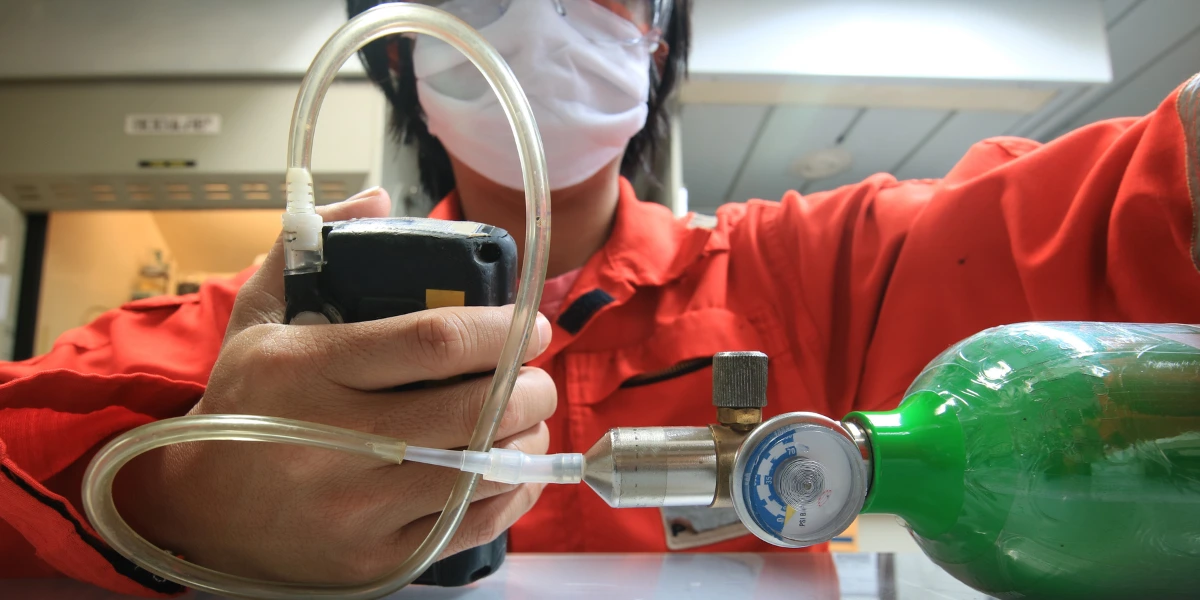
The process is straightforward: Testing exposes your gas detector (such as Blackline Safety’s G7x or G7c) to a known concentration of the target gas or gases that should trigger a response.
For example, if it's a methane detector, you'd expose it to a controlled amount of methane.
- If the detector successfully registers the gas within the acceptable range and triggers all its alarms (beeping, flashing lights, vibration), it passes the bump test.
- If it fails to alarm or the response is sluggish, it indicates a problem that requires immediate attention.
Bump Testing vs. Calibration
It's crucial to understand the difference between a bump test and a full calibration.
A bump test is a go/no-go functional check. A calibration, on the other hand, is a precise procedure where the detector's sensors are adjusted and not just tested.
- Span calibration: Adjusting the sensor to match the value of a known concentration of applied gas that is traceable to a recognized standard. The calibration procedure should follow the equipment manufacturer’s instructions.
- Zero calibration: Establishing a baseline reading for the sensor - 20.9% oxygen and free of any toxic or combustible gas vapors. To maintain a stable baseline, performing zero calibration in fresh air is crucial. If fresh air can’t be confirmed, use zero-grade air or N2 to perform a detector zero calibration. Perform a zero calibration to reestablish baseline as required, and before a span calibration.
While a bump test confirms functionality, a calibration confirms accuracy. Both are vital, but bump testing offers critical, frequent assurance.
Why is Bump Testing Gas Detectors Essential?
For safety managers and business owners, the question isn't whether to bump test, but why it's non-negotiable. The reasons are rooted in the very core of responsible operations:
- Safeguarding lives
- Upholding legal obligations
- Protecting your bottom line
Safeguarding Lives
Most critically, it's about saving lives and preventing catastrophic accidents. Gas detectors are personal protective equipment (PPE) that stand between your workers and invisible hazards. Without regular bump testing, you can't be certain that these devices will respond when an emergency strikes.
A malfunctioning detector might fail to alarm during a gas leak, leading to worker incapacitation, severe injuries, or even fatalities. Investing a few moments in a bump test pales in comparison to the immense human cost and devastating aftermath of a preventable incident.
Upholding Legal Obligations
Beyond the moral imperative, compliance with regulatory requirements is paramount. In Australia, WHS regulators, while not always dictating specific bump test frequency, strongly emphasise the employer's duty of care to ensure equipment is fit for purpose and maintained to manufacturer specifications.
Many industry standards and codes of practice, particularly in high-risk sectors like mining, oil and gas, and confined spaces, explicitly recommend or mandate daily functional checks. Failing to adhere to these best practices could result in significant fines, legal action, and potential irreparable damage to your business's reputation.
Protecting Your Bottom Line
While often overlooked, effective bump testing contributes to significant indirect cost savings. Consider the financial repercussions of a gas-related incident:
- Emergency response
- Medical costs
- Compensation claims
- Regulatory fines
- Legal fees
- Operational downtime
Add to that the intangible but very real cost of reputational damage, lost contracts, and reduced employee morale. Preventing accidents through diligent bump testing helps you effectively shield your business from these crippling expenses, ensuring operational continuity and protecting your long-term viability.
How Often Should You Bump Test?
One of the most common questions we hear is: "How often do we really need to bump test our gas detectors?"
A definitive, one-size-fits-all answer is challenging due to varying workplace conditions. But we recommend performing a bump test daily or before each use or before each use in some cases.
Here are some quotes relating to different situations:
- "It is recommended that this is done by personnel actually operating the apparatus and is strongly recommended that it is performed before each day of use” [AS/NZ 60079.29.2:2016 Selection, installation, use and maintenance of detectors]
- “Gas monitors used for the purpose of atmospheric monitoring within a confined space should be maintained and used in accordance with manufacturer’s instructions and warnings and in reference to AS/NZS 60079” [AS 2865:2009 Confined Space Safe Work Australia Exposure Standards]
- “Any atmospheric testing and monitoring in a confined space should be carried out by a competent person using a suitable, correctly calibrated gas detector” [Safe Work Australia: Code of Practice Confined Spaces]
The correct testing schedule demonstrates that the detector is functioning correctly at the beginning of every shift or before entry into a potentially hazardous area.
Several critical factors will influence, and in some cases even mandate, a different bump test frequency for your specific operations:
|
Factor |
Description |
|
Application/Industry |
High-risk environments like confined spaces, oil and gas, or mining often require daily or pre-use bump testing due to constant exposure to toxic or flammable gases. |
|
Manufacturer's Recommendations |
The manufacturer's guidelines are the primary source for safe operation and maintenance. Deviating from these recommendations can void warranties and compromise safety. |
|
Company Policy |
Your company's internal safety policies and risk assessments should dictate the bump testing schedule, aligning with or exceeding industry best practices and regulatory requirements. |
|
Environmental Conditions |
Extreme conditions like high humidity, extreme temperatures, dust, or corrosive agents can accelerate sensor degradation. In these cases, increasing the bump test frequency is a necessary proactive measure. |
|
Detector Usage |
A detector that has been stored for an extended period requires a pre-use bump test before it's put back into service. |
The consequences of skipping or performing infrequent bump testing are dire. You are essentially operating blind, relying on equipment that may have silently failed.
That puts your workers at unacceptable risk of exposure to hazardous gases and can lead to potential injury, illness, or fatality. For the business, it opens the door to serious regulatory breaches, substantial fines, increased insurance premiums, costly legal battles, and severe reputational damage.
Common Misconceptions Around Bump Testing
Despite its simplicity and critical importance, misunderstandings that can inadvertently compromise safety often surround bump testing. For safety managers and business owners, clarifying these points for your team is crucial.
1. Bump testing is a calibration
That is perhaps the most pervasive misconception and one that can lead to a false sense of security. As we mentioned earlier, bump testing and calibration are different.
A bump test is a functional check. It merely verifies that your detector's sensors are alive and that the alarms work when exposed to gas. It's a quick "go/no-go" signal.
A full calibration, on the other hand, is a precise adjustment of the detector's sensors to ensure they accurately measure and display specific gas concentrations across their detection range.
Both are vital, but they serve distinct purposes. Relying solely on one without the other leaves significant gaps in your safety assurance.
2. My detector has a self-test function, so I don't need to bump test
Many modern gas detectors boast impressive self-test diagnostics, which can check battery levels, internal circuitry, and even sensor connectivity. These features are valuable – they provide an initial layer of confidence that the device is powered on and communicating internally.
However, a self-test does not expose the sensor to actual gas. It cannot detect if a sensor has become blocked by grime, dust, or moisture, if its response time has degraded due to ageing, or if there's a problem with the gas inlet that prevents ambient air (and gas) from reaching the sensor.
A self-test confirms the electronics are functioning, but only a bump test confirms the entire gas detection pathway, from inlet to alarm, is working as intended in real-world conditions.
3. It's too time-consuming or expensive to bump test
This misconception often stems from a short-sighted view that overlooks the true costs of preventable incidents. While there's an initial investment in bump testing gas detectors and a few minutes cost per detector, the alternative is far more costly.
Consider the real expenses if a detector fails in the field:
- Human Cost: The incalculable cost of injuries, long-term health issues, or even fatalities.
- Financial Penalties: Significant fines from Safe Work Australia for non-compliance with duty of care obligations.
- Legal Action: Potential lawsuits, increased insurance premiums, and the hefty fees associated with legal defence.
- Operational Disruption: Production shutdowns, equipment damage, emergency response costs, and loss of revenue.
- Reputational Damage: Irreparable harm to your company's standing, impacting future contracts and employee recruitment.
The minor investment in time and resources for daily bump testing is minimal compared to the very real and devastating consequences of inaction. It's a fundamental part of responsible business practice and worker protection.
Bump Testing with Aegis Sales & Service
The experts at Aegis Sales & Service are here to bump test and calibrate your gas detectors if needed.
We complete an external check of your detector by checking the:
- Sensor filters - not blocked with dirt, mud, chemicals, or any other foreign substance that will impede the sensors from responding to gases in the atmosphere
- External housing - missing screws and cracks in the housing or LCD screen
- Missing parts - clothes clip, compliance/certification sticker
Any issues with these parts can compromise the integrity of your unit.
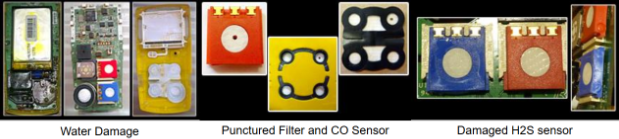
See the image below for examples of the damage we discovered after opening a gas detector for inspection during a manual bump test and calibration carried out in the Aegis Sales & Service workshop.
How we tell when a gas detector fails a bump test:
- The sensor readings will be outside of the manufacturer's allowable range
- The audible alarm will be very soft and hard to hear
- The visual alarms are not working
What we do when a unit fails a bump test:
- The sensor readings are outside of the manufacturer's allowable range: We calibrate or repair the instrument
- The audible alarm is very soft and hard to hear: We perform a service and/or repair
- The visual alarms are not working: We service and/or repair the unit
Don’t leave employee safety to chance, book your gas detectors in for bump testing and/or calibration with Aegis Sales & Service.